

Medical Disclaimer
Educational Use Only
This content is provided for educational and informational purposes only. It does not constitute medical advice, diagnosis, treatment recommendations, or dosage guidance. Pregabalin should only be used under the supervision of a qualified healthcare professional. Always consult a doctor, pharmacist, or other licensed medical provider regarding diagnosis, treatment options, or any questions about medication use
Pregabalin is a widely recognised prescription medication that appears frequently in discussions around neurological conditions and nerve-related care. It is commonly referenced in clinical literature, patient information resources, and regulatory guidance due to its role in how the nervous system processes certain signals. As awareness of pregabalin has increased, so has the number of people seeking general, easy-to-understand information about it.
When individuals search what is pregabalin 75 mg used for? they are often not looking for personal treatment advice, but rather for clear, neutral explanations about why this medication is prescribed, what types of conditions it is associated with, and why the 75 mg capsule strength is mentioned so frequently in educational materials. These searches typically occur before or alongside a consultation with a healthcare professional, as part of an effort to become better informed.
This article provides an educational overview of pregabalin, focusing specifically on the 75 mg capsule strength because it is one of the most commonly referenced standard formulations. The aim is to explain how pregabalin is described in medical contexts, the conditions it is generally associated with in clinical discussions, and the broader regulatory and safety considerations that surround its use. It is designed to support informed awareness rather than influence medical decisions.
What Is Pregabalin?
Pregabalin is a prescription medication classified as a gabapentinoid, a group of medicines commonly discussed in relation to nerve signalling and neurological conditions. Although it is structurally related to gamma-aminobutyric acid (GABA), it does not act directly on GABA receptors.
For broader background information, readers can explore the pregabalin education hub available on GlobalPharmacare.net:
How Pregabalin Is Described Medically
Nervous System Interaction
In clinical and academic literature, pregabalin is described as interacting with voltage-gated calcium channels in the brain and spinal cord. This interaction can influence the release of neurotransmitters involved in nerve signalling.
Because of this mechanism, pregabalin is commonly discussed in relation to:
- Nerve-related discomfort
- Neurological sensitivity
- Conditions involving altered electrical activity in the brain
A Non-Technical Explanation
In simpler terms, pregabalin is often described as helping to calm overactive nerve signals. Rather than blocking pain directly, it changes how strongly certain nerve messages are transmitted. This explains why it is frequently referenced in discussions around nerve pain, epilepsy, and anxiety-related conditions.
Key Takeaways
- Pregabalin belongs to the gabapentinoid class
- It affects nerve signal transmission, not traditional pain pathways
- It is most often discussed in neurological contexts
What Is Pregabalin 75 mg Used For?
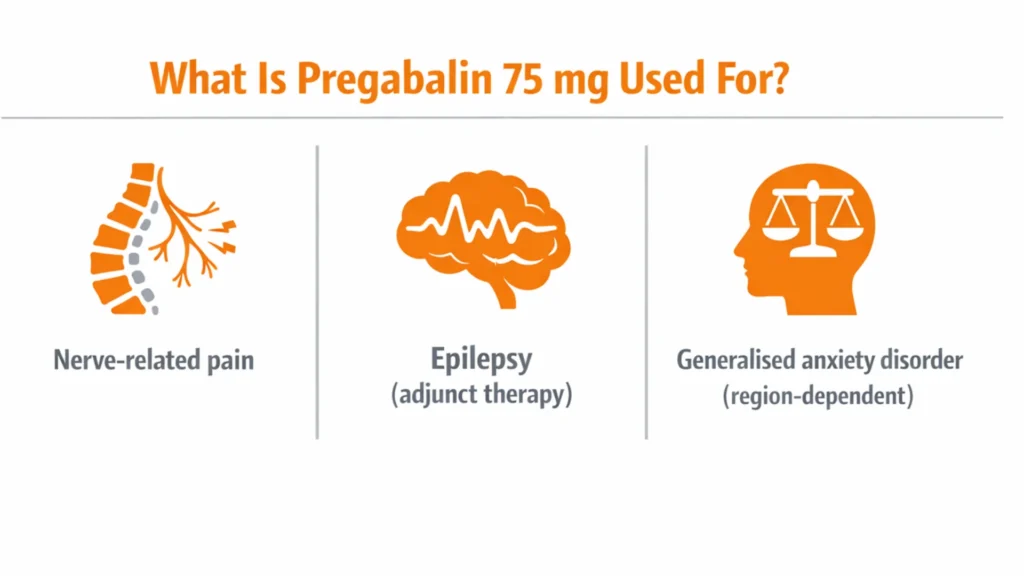
When people ask what pregabalin 75 mg is used for, they are usually seeking a general understanding of the medical conditions that pregabalin is most commonly associated with in clinical and academic literature. These queries typically reflect a desire for background knowledge rather than an assumption that the medication—or a specific strength—is suitable for personal use.
Pregabalin is a prescription-only medicine, and any decision to use it is based on a comprehensive clinical assessment carried out by a qualified healthcare professional. Factors such as medical history, symptom profile, concurrent medications, and regional prescribing guidelines all play a role in determining whether pregabalin may be considered appropriate in a given situation.
Conditions Commonly Associated With Pregabalin
At an educational level, pregabalin is most often discussed in connection with a small number of well-defined medical contexts. These associations reflect how the medicine is described in prescribing information, clinical studies, and regulatory guidance.
Neuropathic (Nerve-Related) Pain
Pregabalin is frequently referenced in discussions about neuropathic pain, a type of pain that arises from damage or dysfunction within the nervous system rather than from tissue injury or inflammation. Examples commonly mentioned in medical literature include nerve pain linked to diabetes, spinal conditions, or previous nerve injury.
Unlike traditional painkillers, medicines discussed in relation to neuropathic pain work by influencing how nerve signals are transmitted. This is why pregabalin appears in educational resources focused on nerve-related discomfort rather than general pain relief.
Epilepsy (Adjunct Therapy)
In epilepsy care, pregabalin may be described as an adjunct (add-on) therapy for certain seizure types. This means it is sometimes discussed alongside other antiepileptic medicines rather than as a standalone treatment.
Its inclusion in epilepsy-related literature is linked to its effects on electrical activity within the brain. Any use in this context is always managed by specialists and guided by established clinical protocols.
Generalised Anxiety Disorder (GAD)
In some regions, including parts of Europe, pregabalin is approved for use in generalised anxiety disorder (GAD). In these settings, it is discussed in relation to persistent anxiety symptoms and heightened nervous system activity.
It is important to note that regulatory approval for anxiety-related use varies by country, which is why pregabalin may be described differently across international medical sources.
Why the 75 mg Strength Is Commonly Referenced
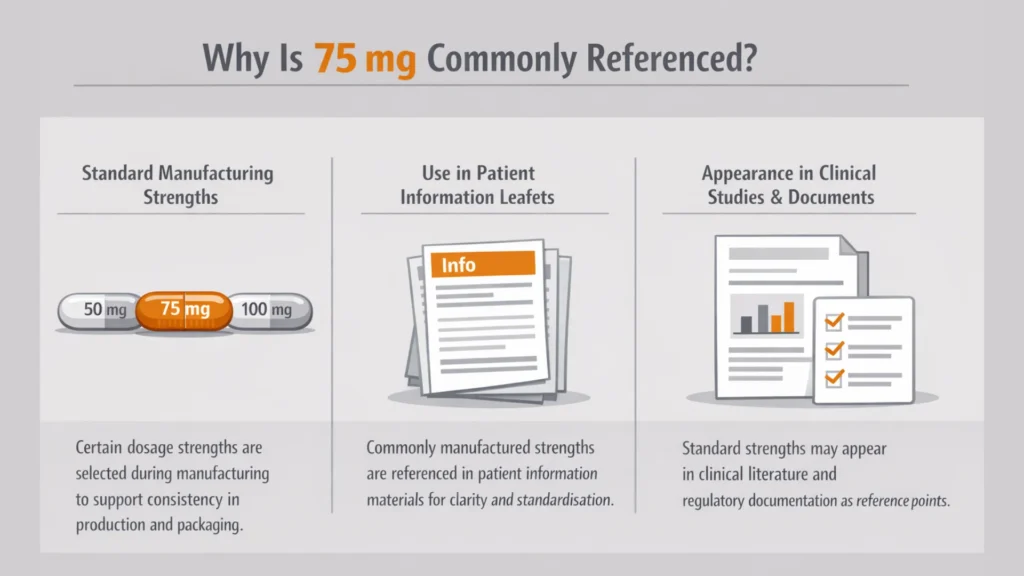
The 75 mg capsule is one of several standardised manufacturing strengths in which pregabalin is produced. Its frequent appearance in educational materials, research studies, and patient information leaflets reflects this standardisation rather than indicating preference or suitability.
Because 75 mg represents a mid-range capsule size, it is often used as a reference point when explaining how pregabalin is formulated or discussed clinically. This does not mean that the 75 mg strength is appropriate for all individuals or conditions.
Ultimately, strength selection and treatment planning are decisions made exclusively by healthcare professionals, based on individual patient needs and regulatory guidance.
Key Takeaways
- Pregabalin is discussed in relation to nerve pain, epilepsy, and anxiety disorders
- The 75 mg capsule is a commonly referenced standard strength
- Suitability is determined only by medical professionals
Why Is 75 mg a Commonly Referenced Strength?
Pregabalin 75 mg is often mentioned in:
- Educational articles
- Clinical studies
- Patient information leaflets
- Regulatory documentation
This reflects how medicines are manufactured and documented rather than indicating preference or recommendation.
Pregabalin 75 mg vs Other Strengths
Pregabalin is available in multiple strengths, and educational comparisons sometimes arise when different capsule sizes are discussed. These comparisons are descriptive rather than prescriptive and focus on regulatory and classification context.
Questions about pregabalin strength classification sometimes come up in this context, particularly around regulation and terminology.
Pregabalin is frequently compared with other medicines used in similar neurological contexts, such as gabapentin, when considering differences in safety and clinical discussion.
Educational overviews are also available that focus specifically on how higher strengths of pregabalin, such as 150 mg, are discussed in clinical contexts.
Related Pregabalin Topics
In educational and clinical literature, pregabalin is frequently discussed across a range of related topics, including the use of different strengths, terminology and naming conventions, regulatory considerations, and commonly referenced alternatives. To avoid unnecessary repetition, these subjects are addressed separately within GlobalPharmacare.net’s pregabalin education resources, each providing focused, topic-specific context. Further clarification on pregabalin naming conventions, brand versus generic terminology, and commonly raised questions is available in a dedicated FAQs and alternatives resource.
Economic and availability considerations surrounding pregabalin, including pricing references and pack size descriptions, are addressed separately to provide system-level context.
General information on how pregabalin dosing frequency is discussed in clinical settings, including questions around the 75 mg strength, is addressed separately to avoid mixing educational context with treatment guidance.
Safety, Dependence & Regulatory Overview
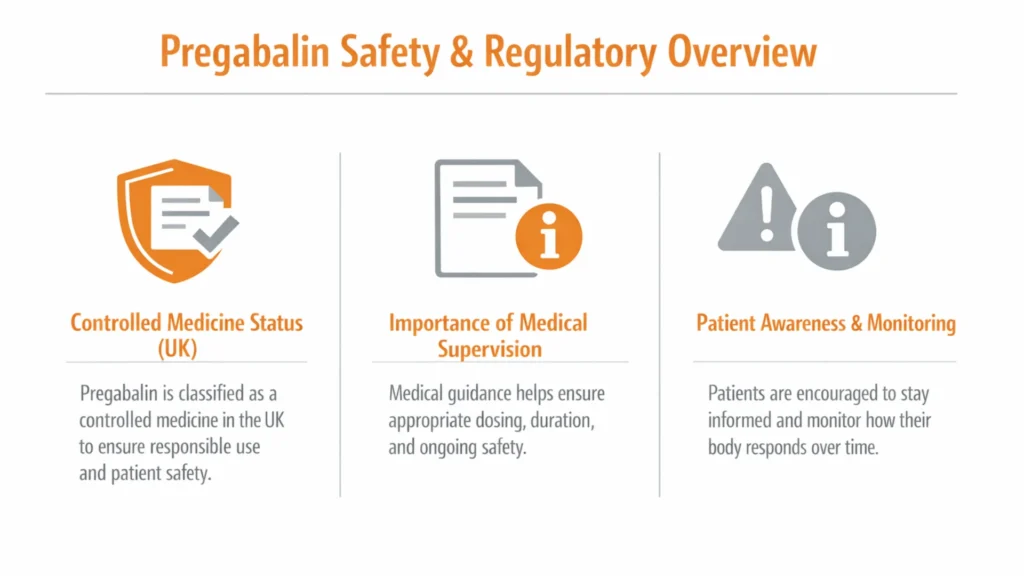
Safety and regulation are key areas of interest for anyone researching prescription medicines such as pregabalin. Because pregabalin affects the central nervous system, its use is closely monitored by health authorities in many countries. Regulatory controls are designed to balance recognised medical uses with the need to reduce the risk of misuse and harm.
Regulatory Classification
In the UK, pregabalin is classified as a controlled medicine under drug control regulations. This classification was introduced following evidence of misuse and concerns about dependence potential when the medication is not used appropriately. As a controlled drug, pregabalin is subject to stricter prescribing, dispensing, and record-keeping requirements than many standard prescription medicines.
Similar regulatory approaches exist in several other countries, although the exact classification and legal framework may differ by region. In some locations, additional prescribing restrictions or monitoring programmes are in place to support safe use and patient awareness.
Authoritative, publicly accessible guidance on approved uses, safety considerations, and patient information is provided by the NHS:
Dependence Awareness
Medical and regulatory literature recognises that pregabalin may carry a risk of dependence in some individuals, particularly when it is used outside prescribed guidance or without appropriate medical oversight. This risk is not the same for everyone and can vary depending on individual health factors, duration of use, and adherence to prescribing instructions.
Because of this potential, healthcare professionals place strong emphasis on:
- Careful patient assessment before prescribing
- Ongoing monitoring during use
- Clear patient education about safe and responsible medication use
These measures are intended to reduce the likelihood of misuse, minimise potential harm, and ensure that pregabalin is used only in medically appropriate contexts.
Key Takeaways
- Pregabalin is a controlled medicine in the UK due to safety and misuse concerns
- Regulatory approaches may vary internationally
- There is recognised dependence potential in some individuals
- Medical supervision and patient education are central to safe use
Commonly Discussed Side Effects (High-Level)
Like many prescription medicines, pregabalin is associated with potential side effects. Educational sources commonly mention:
- Dizziness or drowsiness
- Changes in concentration
- Weight or appetite changes
Not everyone experiences side effects, and their severity varies.
Frequently Asked Questions
No. It is also discussed in relation to epilepsy and anxiety disorders.
Yes. Lyrica is the branded version; pregabalin is the generic name.
Educational materials describe 75 mg as a standard capsule strength, not inherently high or low.
Pregabalin has recognised dependence potential in some individuals, which is why it is regulated.
It is most often discussed in relation to nerve pain, epilepsy, and anxiety disorders in medical literature.
Conclusion
Understanding what pregabalin 75 mg is used for requires a clear distinction between general educational information and individual medical decision-making. While pregabalin is a well-established prescription medication in neurological and nerve-related care, its discussion in educational materials reflects how it is described in clinical literature rather than how it should be used by any specific individual.
The frequent reference to the 75 mg capsule strength is largely a result of standardised manufacturing and its common appearance in patient leaflets, research studies, and regulatory documentation. This visibility should not be interpreted as an indication of suitability, effectiveness, or preference for personal use. Decisions regarding whether pregabalin is appropriate, and in what form, are always made by qualified healthcare professionals following a full clinical assessment.
By approaching pregabalin through a neutral, educational lens, readers can better understand why the medication is associated with certain medical conditions, how it is regulated, and why safety considerations are emphasised internationally. This type of informed awareness supports more meaningful discussions with healthcare providers without replacing professional guidance.
For further neutral information on medication standards, safety considerations, and regulatory frameworks, readers may explore GlobalPharmacare.net’s educational resources, which are designed to support informed understanding rather than provide medical advice.