

Medical Disclaimer
This article is for educational purposes only and is not a substitute for professional medical advice, diagnosis, or treatment. Discussions of modalert tolerance should be understood in a general informational context, as individual responses to modafinil can vary over time. This content does not recommend self-adjusting use, changing routine, or making personal treatment decisions without guidance from a qualified healthcare professional. Persistent concerns about reduced effectiveness, sleep disruption, or unwanted effects should be discussed with an appropriate medical provider.
People often ask whether Modalert can feel less effective over time, especially when it becomes part of a broader routine focused on wakefulness, productivity, or cognitive support. Questions about long-term use usually come up when someone notices a change in how alert or focused they feel, even if the product itself has not changed. This is where modalert tolerance often enters the discussion. However, the experience can vary widely from one person to another. In many cases, the conversation is not only about the product, but also about sleep, stress, expectations, and everyday habits that may shape perceived results over time. Readers looking for product-specific Modalert information can also review Modalert 200 mg details.
What People Usually Mean by Modalert Tolerance
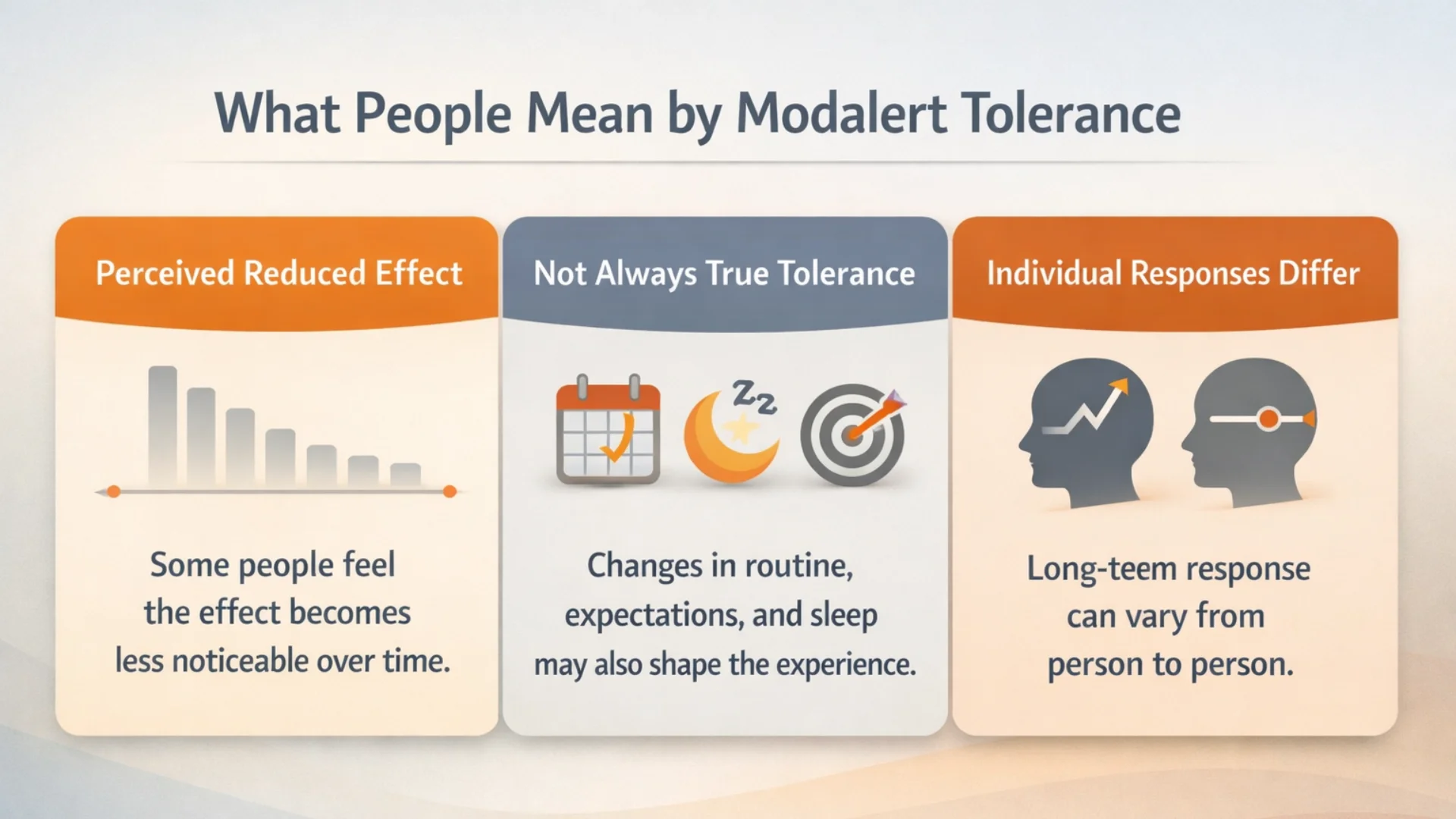
When readers talk about modalert tolerance, they are often referring to a perceived reduced effect after longer use. In practical terms, this may mean that the alertness or mental sharpness they once noticed feels less obvious than it did at the start. Some individuals describe this as Modalert “not hitting the same way,” while others wonder whether it has stopped working.
That question is understandable, but it can be more complex than it first appears. A changing experience over time does not always mean the body has developed a straightforward tolerance in the way people sometimes assume. In some cases, the initial contrast between feeling tired and feeling more awake may simply become less noticeable once a new routine becomes familiar.
Expectations can also shift. What once felt like a dramatic improvement may later feel more subtle, even if wakefulness support is still present. This is one reason why discussions of modalert tolerance can be difficult to simplify. Some people may notice changes in effectiveness over time, while others may not report the same experience at all. Individual response, lifestyle factors, and overall health context can all influence how long-term use feels.
Key Takeaways
- People often use “tolerance” to describe a reduced or less noticeable effect over time.
- A perceived change in effect is not always the same as clear biological tolerance.
- Individual experiences with long-term use of Modalert can vary.
Why Long-Term Use Questions Come Up
Questions about long-term use usually arise when readers begin paying closer attention to consistency. Early on, the experience may feel more noticeable because the contrast with fatigue or low alertness is stronger. Over time, however, routine can change perception.
Sleep debt is one major reason these questions come up. Someone who is consistently sleeping poorly may begin to feel that wakefulness support is not as strong as before. In that situation, it may be tempting to assume modalert tolerance, when sleep quality itself could be affecting the overall experience. This topic also connects naturally with Modalert and Sleep: Effects on Sleep Quality & Timing, while broader sleep debt patterns are also discussed by Sleep Foundation.
Workload and stress may also play a role. During periods of heavy mental demand, people may expect the same level of output despite increasing pressure, distraction, or burnout. If performance feels less sharp, they may interpret that as the product losing effectiveness, even though the issue could involve several overlapping factors.
Rising expectations are another common part of the picture. What initially felt like a meaningful lift in wakefulness may later come to feel normal, especially when someone adapts to a new baseline. That does not always mean Modalert has stopped working. Instead, it may mean the experience is being judged against a different standard than before.
Key Takeaways
- Long-term questions often come from noticing a change in perceived effectiveness.
- Sleep debt, stress, workload, and routine may influence how Modalert feels over time.
- Some people may assume tolerance when other factors may also be involved.
Modalert Tolerance vs Dependence vs Habit
Tolerance Concerns
When readers raise tolerance concerns, they usually mean that the effects feel less noticeable than they once did. This can include a feeling that wakefulness support over time is not as strong, or that the difference between before and after feels smaller. These concerns are understandable, but they should be discussed carefully. A reduced perceived effect does not always point to one single cause, and it may not mean the same thing in every person.
Dependence Misconceptions
Discussions about Modalert and dependence often overlap with modalert tolerance questions, but they are not the same issue. This distinction matters. Tolerance generally refers to a change in response over time, while dependence concerns involve a different set of questions about reliance, withdrawal, or difficulty functioning without a substance. For general modafinil safety context, the FDA Medication Guide for modafinil discusses dependence and misuse in broader terms.
Readers sometimes blend these ideas together, especially in online discussions. However, asking whether Modalert feels less effective is not automatically the same as asking whether someone is dependent on it. Keeping those conversations separate can help make the topic clearer and less sensational.
For readers who want broader context before thinking about long-term concerns, it may also help to review this Modalert Guide for a balanced overview.
Existing Sleep Habits
Pre-existing sleep patterns can strongly shape the experience. Irregular bedtimes, accumulated sleep debt, and inconsistent routines may already affect sleep quality before any wakefulness-supporting product enters the picture.
The NHS insomnia guidance highlights the importance of regular sleep habits and a supportive sleep environment. Therefore, it can be difficult to separate product-related effects from the impact of poor sleep hygiene alone.
Habit and Routine Effects
Habit can shape perception more than many people expect. When someone follows the same routine repeatedly, the subjective boost may feel less dramatic simply because it has become familiar. Daily patterns, work expectations, and learned associations can all influence how noticeable the benefits seem.
For example, a person who expects a very strong sense of mental drive each time may feel disappointed when the experience becomes subtler. Another person may still be benefiting from wakefulness support but no longer notices it in the same way because it has become part of their normal baseline. In this sense, habit and routine effects may sometimes influence perceived benefit without fully explaining it.
Key Takeaways
- Tolerance concerns usually refer to feeling a reduced effect over time.
- Dependence concerns are different and should not be treated as the same discussion.
- Habit, routine, and expectation can shape how benefits are perceived.
What Can Influence Perceived Effectiveness Over Time
A change in effectiveness over time does not always have one simple explanation. Several factors may influence how effective it seems from day to day or over longer periods.
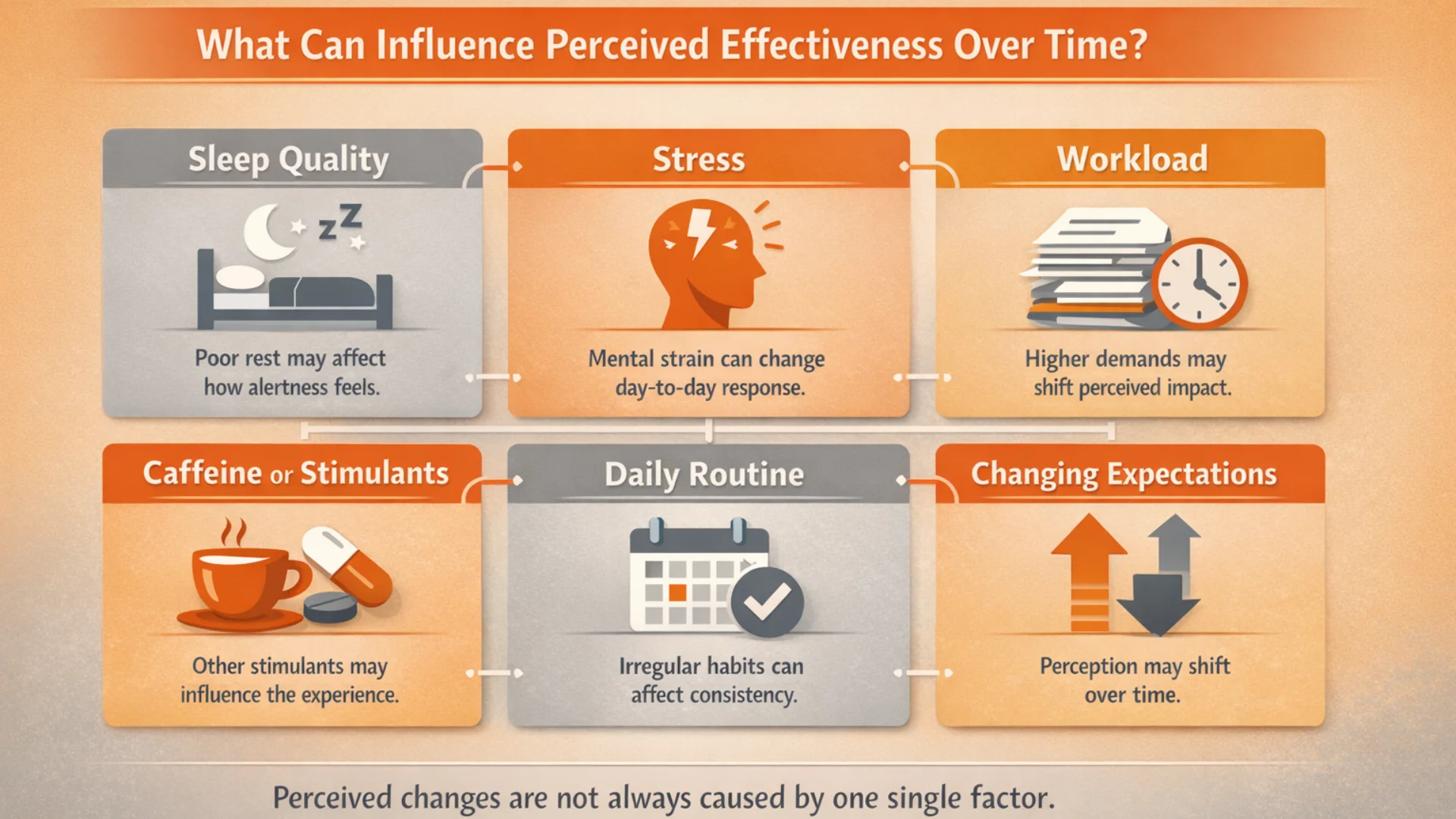
Sleep quality is often one of the biggest factors. Poor sleep, inconsistent sleep timing, or ongoing sleep disruption may make wakefulness support feel less noticeable. This is especially relevant for readers already exploring how alertness and sleep interact.
Stress can also matter. High stress levels may reduce concentration, increase mental fatigue, and make it harder to feel productive even when wakefulness is improved. In that situation, someone may think the product is doing less, when the broader issue may involve workload and nervous system strain.
Workload itself can shift perception. More demanding tasks, longer hours, and sustained cognitive pressure can create a sense that performance has changed, even if the underlying wakefulness effect is still present.
Caffeine or other stimulants may also influence the experience. Layering multiple sources of stimulation can make it harder to judge what is contributing to alertness, jitteriness, or fatigue later in the day.
Inconsistent routine is another factor. Sleep timing, meal timing, hydration, work schedule, and general lifestyle habits may all affect how consistent the experience feels over the long term.
Expectation shifts are easy to overlook. A person may compare current effects to their earliest experiences, which can create the impression of decline even when their body and routine have simply adapted.
Finally, individual physiology matters. Responses differ, and long-term use of Modalert may not feel identical for everyone. This is one reason medically neutral guidance tends to avoid broad guarantees. Readers trying to separate wakefulness from concentration-related expectations may also find it useful to read Does Modalert Improve Focus or Just Wakefulness?.
Key Takeaways
- Sleep, stress, workload, and routine can all influence perceived long-term effectiveness.
- Caffeine, stimulants, and changing expectations may complicate how effects are judged.
- A change in perceived effect does not always point to one simple cause.
When Long-Term Concerns Deserve More Attention
Some long-term questions can be monitored through self-awareness and routine review, but there are situations where concerns deserve closer attention. If someone has an ongoing concern about modalert tolerance, it may be worth looking beyond the idea of tolerance alone.
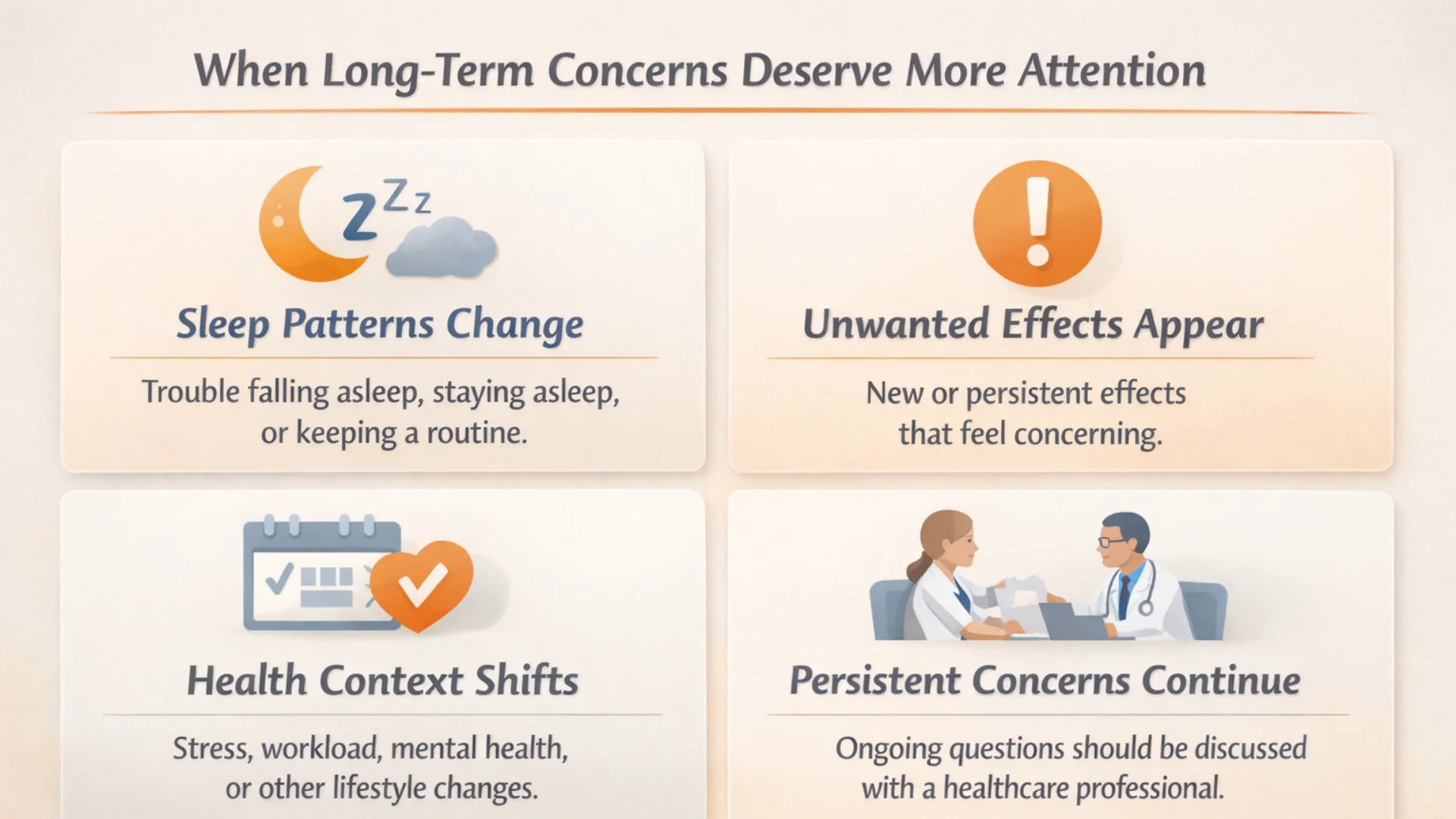
Changing sleep patterns are one example. If sleep quality has worsened, or if someone notices more difficulty falling asleep, staying asleep, or maintaining a consistent schedule, that broader context may matter. Persistent disruption may affect how wakefulness support feels and should not be ignored. General insomnia-related patterns are also outlined by the NHS.
Unwanted effects are another reason to take a closer look. Readers who notice changes they find uncomfortable or concerning may benefit from reviewing Modalert Side Effects and considering whether professional input is appropriate.
A shift in overall health context also matters. Stress levels, work demands, mental health, other stimulants, and general lifestyle changes can all influence how the experience feels over time. Because these factors overlap, persistent concerns should be discussed with a qualified healthcare professional rather than reduced to a single explanation.
This is especially important when questions become ongoing rather than occasional. Long-term concerns do not always indicate a serious problem, but they do deserve thoughtful attention when patterns continue.
Key Takeaways
- Persistent concerns about reduced effectiveness deserve a broader review.
- Sleep changes, unwanted effects, and health context may all be relevant.
- Ongoing questions should be discussed with a qualified healthcare professional.
Frequently Asked Questions
Some individuals may feel that Modalert becomes less noticeable over time, but responses can vary. In some cases, sleep, stress, routine, or changing expectations may also influence that perception.
No. Modalert tolerance and dependence are different concepts. Questions about tolerance usually focus on reduced perceived effect, while dependence involves a separate set of concerns. For additional drug information, MedlinePlus provides general modafinil guidance.
Yes, poor sleep may affect how effective wakefulness support feels. Ongoing sleep disruption can make alertness harder to judge clearly over time.
Long-term concerns often come up when someone notices a change in response, has questions about sleep or routine, or wants to understand whether reduced effect is common
Professional advice may be appropriate when concerns continue over time, sleep patterns change noticeably, unwanted effects appear, or the overall health context has shifted. General signs that sleep problems may need medical attention are also outlined by Mayo Clinic.
Conclusion
Long-term response to Modalert may vary, which is why modalert tolerance should not be oversimplified. When people ask whether Modalert becomes less effective, the answer is often more nuanced than a simple yes or no. Sleep, routine, stress, workload, and changing expectations may all affect perceived effectiveness over time, and individual responses can differ.
For readers exploring long-term use, it helps to approach modalert tolerance carefully and practically. A perceived change in effect does not always mean the same thing, and broader context often matters. To build a fuller understanding, readers can explore related educational content across GlobalPharmacare.net, including its broader Nootropics section.
Actionable Steps
- Review related educational pages to better understand wakefulness, sleep, and side-effect context.
- Track patterns in sleep, alertness, stress, and daily routine to spot possible influences.
- Seek professional input if concerns about long-term effectiveness or side effects persist.
Author Note
Paul Harris is a clinical pharmacist and lead content strategist at Globalpharmacare.net. With a Doctor of Pharmacy (Pharm.D.) and a background in neurobiology, he focuses on clear, evidence-based education around wakefulness-related compounds, sleep patterns, and long-term use considerations. His work emphasizes practical, medically neutral guidance that helps readers better understand topics such as perceived reduced effectiveness, routine-related changes, and broader wellness factors that may influence individual experience over time.