When people search for the Nucynta Generic Name, they are usually trying to understand whether Nucynta is the same as tapentadol, how generic medicines work, and why availability and pricing differ across countries. In today’s global healthcare landscape, brand names can change from one market to another, but the active ingredient often remains identical.
Understanding the Nucynta generic name is especially important for readers comparing brand versus generic medications, researching international availability, or trying to make sense of why the same medicine appears under different labels. This guide provides a clear, medically neutral explanation of Nucynta, its generic name tapentadol, and how brand-name and generic availability works worldwide—without offering medical advice or treatment recommendations.
What Is the Generic Name of Nucynta?
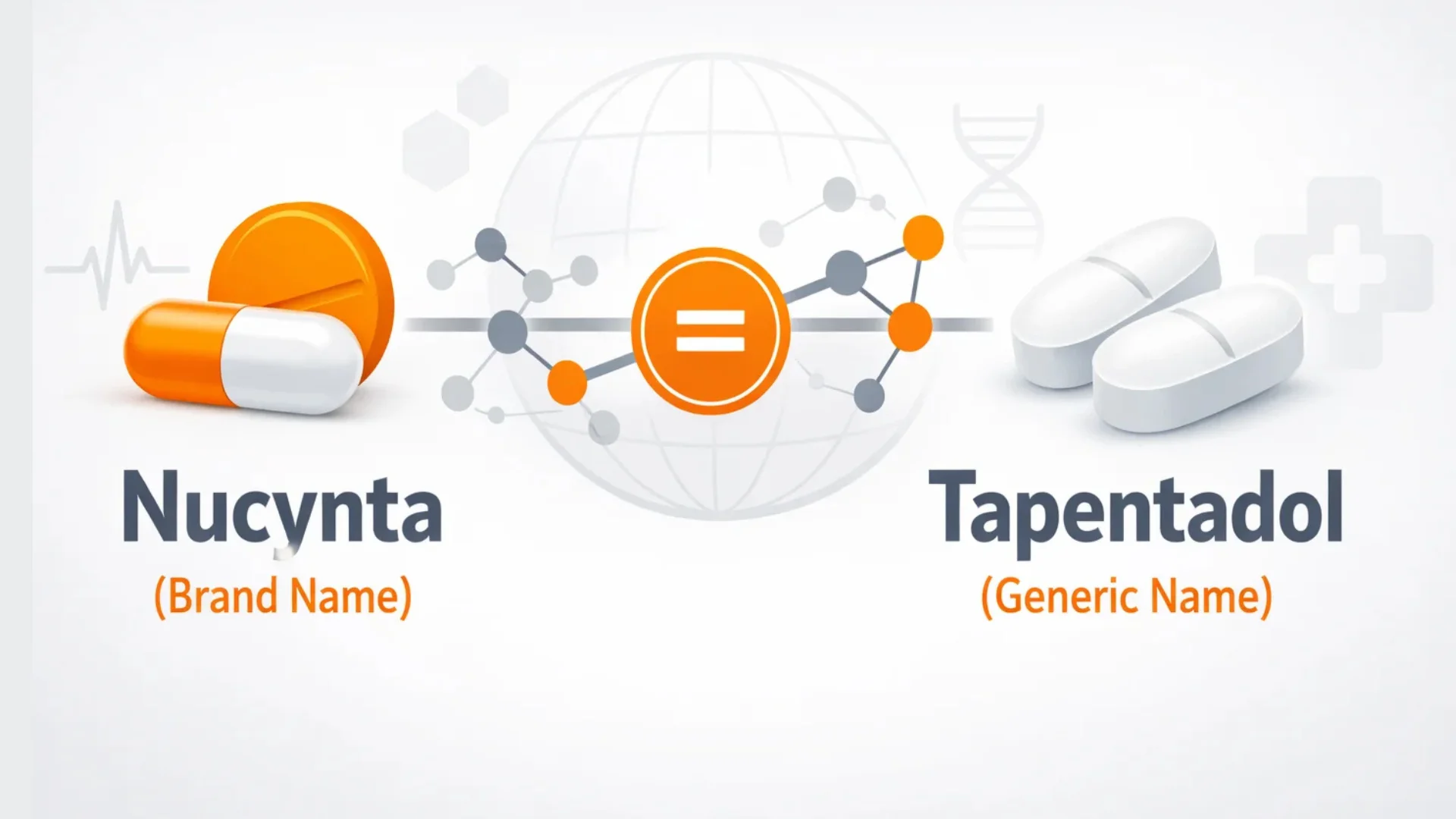
The generic name of Nucynta is tapentadol. Nucynta is simply a brand name used by the manufacturer, while tapentadol refers to the active pharmaceutical ingredient itself.
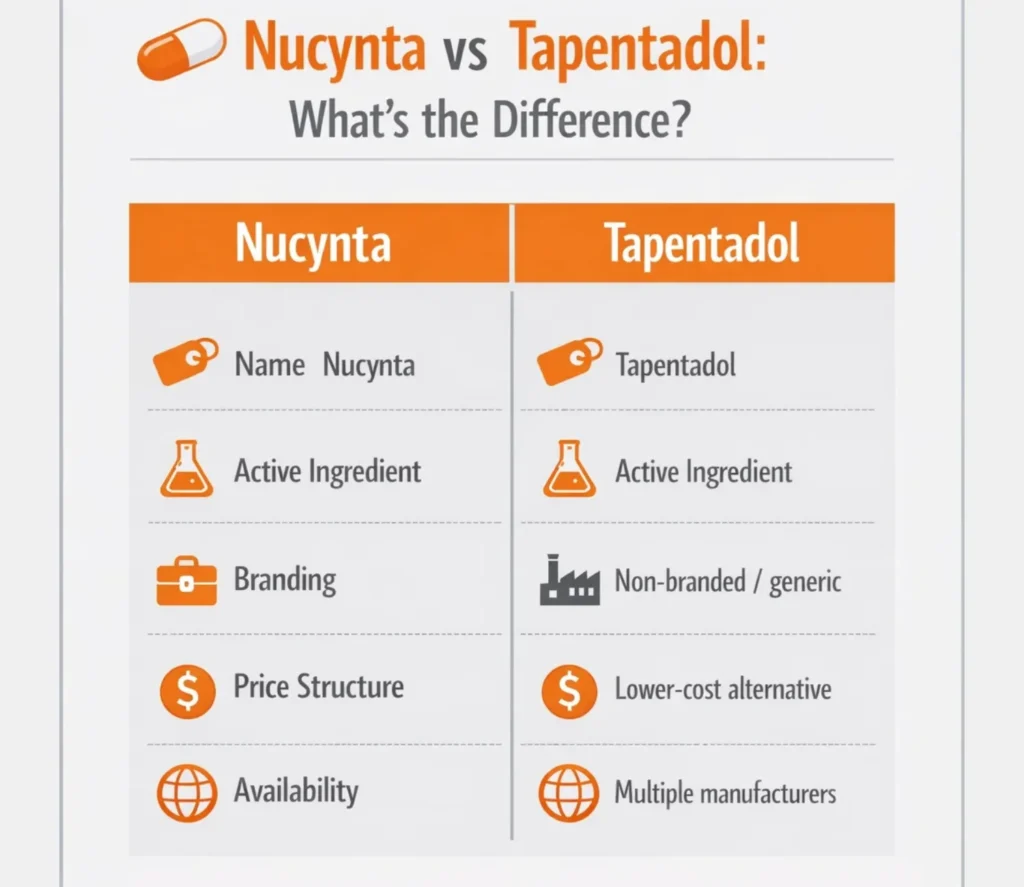
In practical terms, when someone asks, “Is Nucynta the same as tapentadol?”, the answer is yes—they contain the same core compound. The difference lies in branding, manufacturer, packaging, and how the product is marketed or distributed in different regions.
For readers seeking a deeper explanation of why the generic name matters, this internal resource provides additional context:
👉 What Is Nucynta Used For and Why Its Generic Matters
Key Takeaways
- Nucynta is a brand name
- Tapentadol is the generic name
- Both contain the same active ingredient
- Differences are commercial, not chemical
Understanding Brand Names vs Generic Names
Brand-name medications are developed, patented, and marketed by pharmaceutical companies. During the patent period, only the brand owner has the legal right to sell the drug under that name.
Once patents expire, other manufacturers may produce generic versions, provided they meet strict regulatory standards for identity, strength, quality, and purity. Generic medicines are required to match the original drug’s active ingredient and performance characteristics.
A clear, authoritative explanation of how generic drugs work is available from the U.S. Food and Drug Administration here:
👉 Generic Drug Facts (FDA)
This resource explains how generic drugs compare to brand-name medicines and why they are considered equivalent under regulatory standards.
Why Medications Have Different Names in Different Markets
The same medicine may appear under different brand names—or only as a generic—depending on regional factors such as:
- Patent status
- National regulatory approvals
- Healthcare policy and reimbursement systems
- Pricing and access strategies
For global oversight and coordination of medicines, the World Health Organization provides a comprehensive overview:
👉 Medicines Overview (WHO)
Because of these differences, many countries do not sell the Nucynta brand at all and rely entirely on generic tapentadol products.
What Is Tapentadol? (High-Level Overview)
Tapentadol is a centrally acting analgesic and the active ingredient found in Nucynta. This article focuses strictly on identification, naming, regulation, and availability, rather than medical use or dosing.
For an objective public-health reference, the MedlinePlus database provides an overview here:
👉 Tapentadol Information (MedlinePlus – NLM)
For informational browsing purposes, tapentadol products are commonly grouped under:
👉 Tapentadol Product Category
Immediate-Release vs Extended-Release Forms
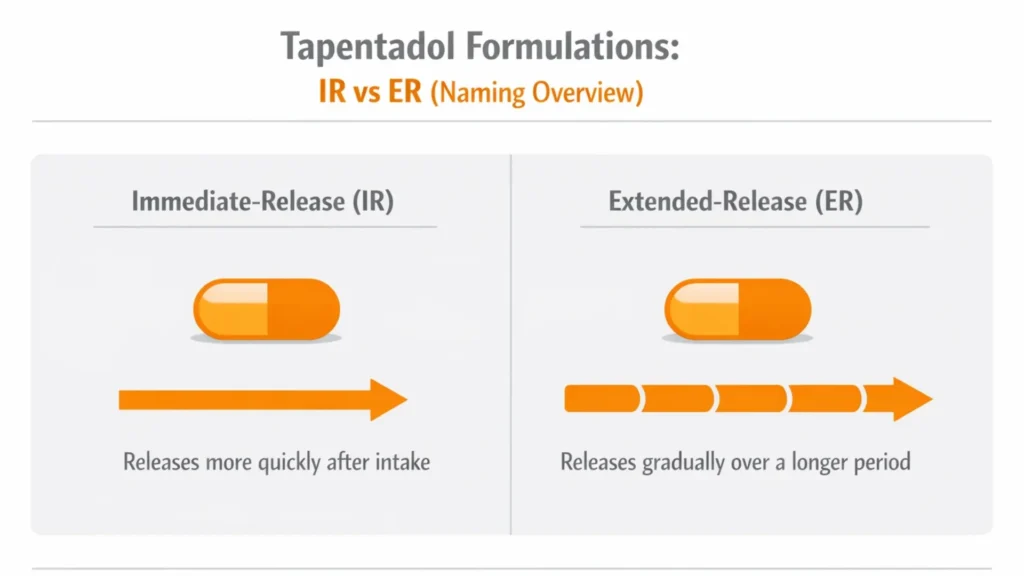
Tapentadol may be manufactured in two primary formulations:
Immediate-Release (IR)
Designed to release the active ingredient more quickly after administration.
Extended-Release (ER)
Designed to release the active ingredient gradually over a longer period.
These terms describe release timing only, not strength or intended medical use. Availability of IR and ER formulations depends on country-specific regulatory approval and market demand.
Nucynta vs Generic Tapentadol: Is There a Difference?
From a regulatory standpoint, Nucynta and generic tapentadol are considered equivalent in terms of their active ingredient and required manufacturing standards.
Generic manufacturers must demonstrate that their tapentadol products meet the same quality benchmarks as the brand-name version. Any differences typically relate to:
- Branding and packaging
- Manufacturer identity
- Price and distribution channels
Key Takeaways
- Same active ingredient
- Same regulatory quality standards
- Differences are branding-related, not chemical
Generic Availability of Tapentadol Worldwide
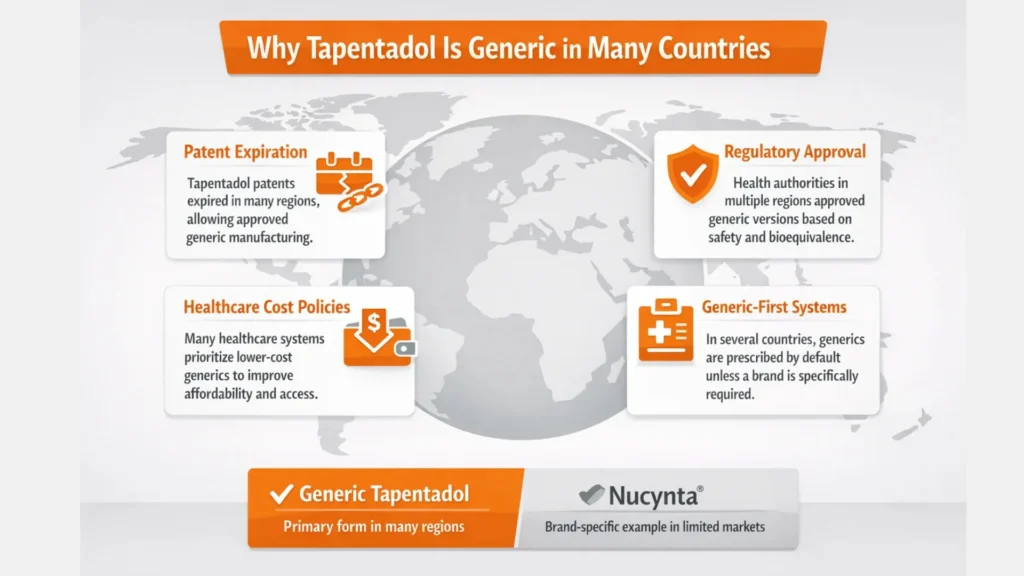
Generic tapentadol availability varies widely across regions due to differences in:
- Patent timelines
- National healthcare systems
- Cost-containment policies
Many healthcare systems prioritize generic medicines to improve affordability and access. In such regions, tapentadol may be available only as a generic, with no branded Nucynta equivalent.
A detailed discussion of timing and availability is available here:
👉 When Will There Be a Generic for Nucynta?
Safety, Regulation, and Classification
Tapentadol is a regulated medication in many jurisdictions. Its legal classification, prescription requirements, and monitoring systems vary by country.
For authoritative information on drug regulation and safety oversight, consult:
This article does not provide guidance on use, dosage, or suitability.
Cost & Accessibility: Why Generics Matter
One of the main reasons readers search for the Nucynta Generic Name is cost comparison. Generic medicines are typically less expensive because they do not include:
- Original research and development costs
- Brand marketing expenses
- Market exclusivity pricing
Key Takeaways
- Generics reduce healthcare costs
- Pricing differences are economic, not chemical
- Generic naming improves global access to medicines
FAQs: How Often Can You Take Lyrica 75 mg
The generic name of Nucynta is tapentadol.
Yes. Tapentadol and Nucynta contain the same active ingredient; the difference is branding.
Availability varies by country, but many regions rely primarily on generic tapentadol.
Generic versions avoid branding, marketing, and exclusivity costs.
Yes. Regulation and classification differ by country.
Conclusion
Understanding the Nucynta Generic Name plays an important role in reducing confusion around medication branding, pricing structures, and international availability. Many prescription medicines appear under different names depending on the country, manufacturer, or regulatory environment, which can make it difficult for readers to determine whether two products are truly different or simply labeled differently.
In the case of Nucynta, recognizing that tapentadol is the generic name clarifies that Nucynta and tapentadol are chemically identical at the active ingredient level. The differences that exist between them are not related to composition or pharmaceutical quality, but instead stem from branding strategies, packaging, market authorization, and regional healthcare policies.
From a global perspective, understanding generic naming also helps explain why some countries may offer tapentadol only as a generic product, while others market it under a specific brand name such as Nucynta. These distinctions are influenced by patent timelines, national drug approval processes, healthcare funding models, and cost-control measures rather than by differences in the medicine itself.
For readers comparing options or researching international access, familiarity with the Nucynta Generic Name provides valuable context. It helps prevent misunderstandings, supports informed research, and allows individuals to recognize equivalent medications across different markets without assuming variations in quality or effectiveness.
Importantly, the purpose of this guide is educational clarity only. It is not intended to promote self-treatment, offer medical advice, or provide guidance on medication use. Instead, it aims to explain how naming conventions work within pharmaceutical systems, empowering readers with accurate information about branding and generic availability in a global healthcare environment.
Medical Disclaimer
This educational guide regarding the Nucynta generic name (tapentadol) is for informational purposes only and does not constitute medical advice or a clinical prescription. Tapentadol is a potent Schedule II (or equivalent) controlled substance with a significant risk for misuse, addiction, and life-threatening respiratory depression. It must be used strictly as directed by a licensed healthcare professional. Never attempt to switch between branded and generic formulations without medical supervision, as individual response and regulatory approvals vary by region. If you have questions about your pain management plan, please consult your prescribing physician.
Author Note
This pharmaceutical naming guide was authored and clinically reviewed by Paul Harris, PharmD. Paul is a Doctor of Pharmacy with expertise in global medicine accessibility and the regulatory standards of generic bioequivalence. His work focuses on helping patients navigate the complexities of international drug branding to ensure they have accurate, safe, and science-backed information. Paul is a member of several pharmaceutical advocacy groups dedicated to improving health literacy and patient safety in the global digital landscape.