
Medical Disclaimer
Educational Use Only
This content is provided for informational and educational purposes only and is not intended as medical advice, diagnosis, or treatment. The information presented here should not be used as a substitute for professional medical guidance.
Always consult a qualified healthcare professional regarding any questions about medications, health conditions, or treatment options. Never disregard or delay seeking professional advice based on information found in this article.
Searches for is pregabalin 150 mg a narcotic? reflect a common and understandable concern. Pregabalin is frequently prescribed for nerve-related conditions and chronic pain syndromes, which leads many people to assume it belongs to the same category as opioids or traditional narcotics. The confusion is further reinforced by the fact that pregabalin is regulated in several countries, including the UK and the United States.
This article provides a clear, factual explanation of pregabalin’s drug classification, how it differs from narcotics and opioids, and why regulatory controls exist. The goal is to help readers understand medical terminology, legal classifications, and safety considerations—without offering medical advice or treatment guidance.
What Does the Term “Narcotic” Mean?
Medical vs Legal Definitions
The word narcotic has different meanings depending on context.
Medically, it traditionally refers to opioid medications that relieve pain by acting on opioid receptors in the brain, such as morphine or codeine. In modern clinical practice, the term is used less often because it lacks precision.
Legally, however, narcotic may be used in drug-control frameworks to describe substances under regulation. These legal classifications are shaped by policy and misuse risk rather than pharmacological action, as outlined in the DEA drug scheduling explanation.
What Is Pregabalin?
Drug Class and Mechanism (Non-Technical)
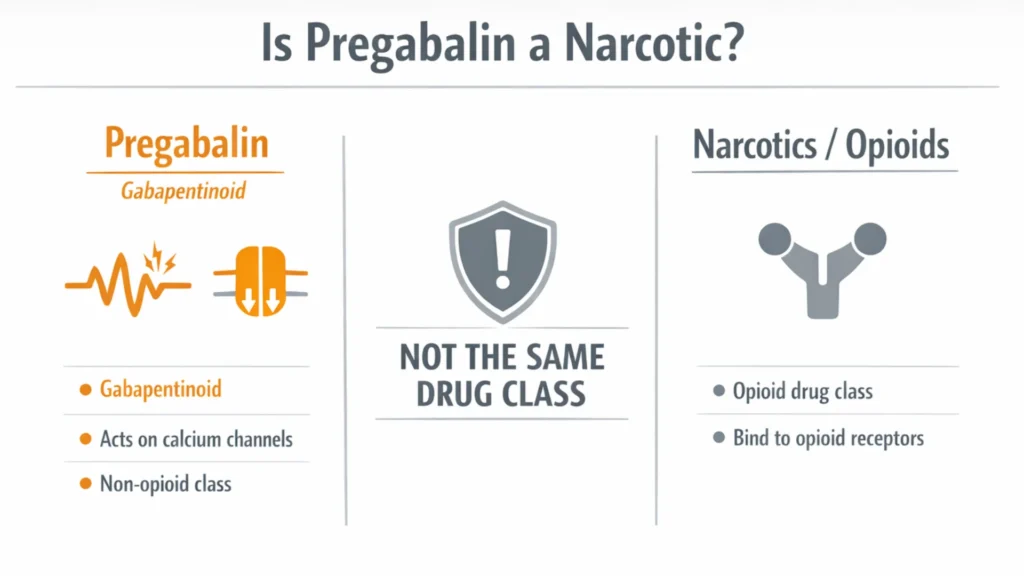
Pregabalin belongs to a class of medicines called gabapentinoids. These drugs reduce excessive nerve signalling by influencing calcium channels in nerve cells.
Crucially, pregabalin does not act on opioid receptors, which is why it is not considered a narcotic or opioid medication.
For a broader educational overview of how pregabalin is commonly discussed in clinical contexts, including its general uses, readers may find a dedicated guide helpful.
For general educational reference, readers can explore the Pregabalin medication category to understand how these medicines are grouped.
Approved Medical Uses (High-Level Overview)
Pregabalin is internationally approved for nerve-related conditions, certain seizure disorders, and anxiety-related diagnoses. Its use in pain management does not make it a narcotic—many non-opioid drugs are used for pain.
Key Takeaways
- Pregabalin is a gabapentinoid, not an opioid
- It targets nerve signalling, not opioid pathways
- Medical use does not define narcotic status
Is Pregabalin 150 mg a Narcotic?
Clear Answer With Explanation
No pregabalin 150 mg is not a narcotic. It is neither an opioid nor classified as a narcotic in pharmacological terms.
The 150 mg strength does not affect classification. Drug categories are determined by mechanism of action, not dosage.
Readers researching this specific strength can review a neutral product overview at Pregalin 150 mg. Lower and higher strengths, such as Pregalin 75 mg and Generic Lyrica 300 mg, remain in the same drug class.
Why Pregabalin Is Often Confused With Narcotics
Confusion arises because pregabalin:
- Is used for pain-related conditions
- Can cause relaxation or drowsiness
- Is regulated as a controlled medicine in some countries
These similarities create assumptions, but they do not change pharmacological reality.
Key Takeaways
- Pregabalin 150 mg is not a narcotic
- Dosage strength does not alter classification
- Regulation does not equal opioid status
Pregabalin vs Opioids and Narcotics
How Pregabalin Works Differently
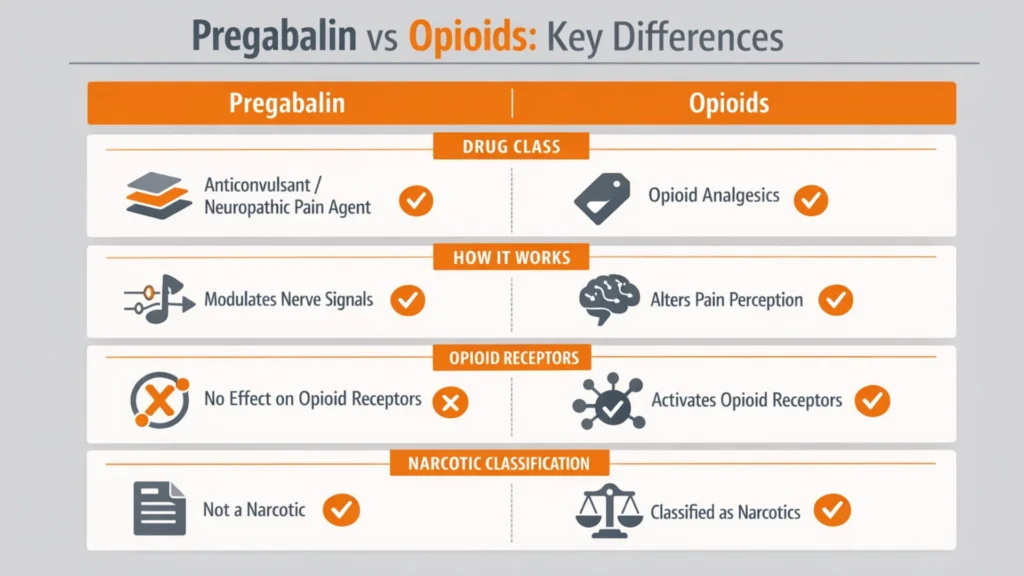
Opioids relieve pain by binding to opioid receptors, which can also activate reward pathways in the brain. This explains their euphoric effects and higher addiction risk.
Pregabalin works through nerve signal modulation, not opioid receptor activation. This makes comparisons such as “pregabalin vs narcotics” pharmacologically inaccurate.
Contextual Comparison
For contrast, opioid-based pain medicines such as tapentadol fall into a different category entirely. Educational references include the Tapentadol medication category and this Tapentadol chronic pain overview.
Key Takeaways
- Pregabalin and opioids act on different systems
- Pregabalin does not trigger opioid receptors
- Similar use cases do not equal similar drug classes
What Can Patients Do While Waiting?
Regulatory Status in the UK
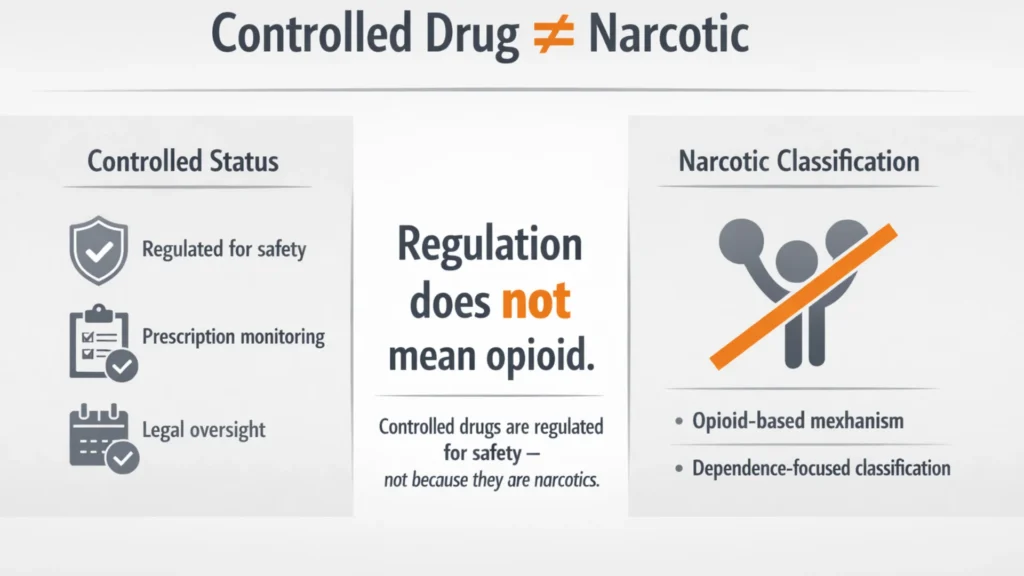
In the UK, pregabalin is classified as a controlled medicine. Oversight involves bodies such as the Medicines and Healthcare products Regulatory Agency (MHRA), and patient-facing guidance is available via the NHS – Pregabalin.
Controlled status reflects misuse-prevention efforts, not narcotic classification.
Regulatory Status in the United States
In the US, pregabalin (marketed as Lyrica) is regulated under the FDA – Lyrica (pregabalin) overview. Educational drug information is also available via MedlinePlus – Pregabalin.
Key Takeaways
- Controlled ≠ narcotic
- Regulation focuses on safety and monitoring
- Global rules differ by jurisdiction
Dependence, Misuse, and Safety Considerations
Dependence vs Addiction
Dependence refers to physical adaptation, while addiction involves compulsive use despite harm. These terms are often incorrectly treated as identical.
Pregabalin may lead to physical dependence in some cases, but this differs fundamentally from opioid addiction mechanisms.
Why Controls Exist
Regulatory frameworks aim to:
- Encourage responsible prescribing
- Reduce non-medical use
- Improve patient safety
These safeguards do not indicate narcotic behavior.
Frequently Asked Questions
No. Pregabalin is a gabapentinoid, not an opioid or narcotic.
Because it treats pain and is controlled in some countries.
No. Legal status varies by country.
Physical dependence may occur, but this is not opioid addiction.
Narcotics act on opioid receptors; pregabalin modulates nerve signalling.
Conclusion
So, is pregabalin 150 mg a narcotic?
The evidence-based answer is no.
Pregabalin is a non-opioid gabapentinoid with a mechanism of action that differs entirely from narcotics and opioids. It does not act on opioid receptors, and its classification is based on pharmacology—not dosage strength or pain-related use.
While pregabalin is regulated in some regions, this reflects safety monitoring and misuse-prevention efforts, not narcotic identity. Understanding this distinction helps reduce confusion and supports informed, responsible discussions about medication classification.
Final Takeaways
- Narcotic ≠ controlled medicine
- Pregabalin is not an opioid
- Always rely on authoritative sources and licensed professionals
Author Note
Content Review and Editorial Standards
This article was written and reviewed to ensure accuracy, clarity, and compliance with current medical terminology and regulatory understanding. The focus is on explaining drug classifications and public-health context without promoting misuse or providing dosage or treatment recommendations.
References used include recognized public health and regulatory sources, and the content is updated to reflect general, non-clinical information intended to support informed decision-making.